
 en
en
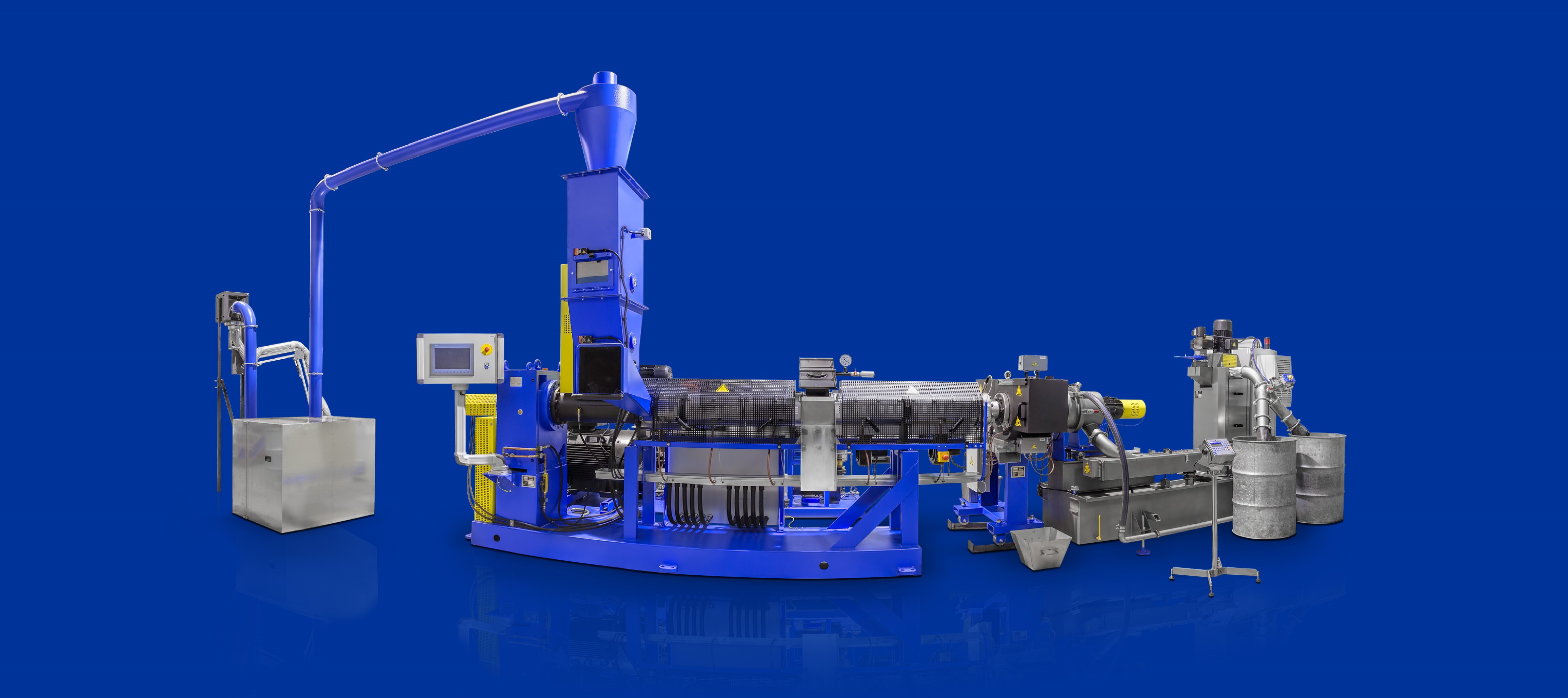
Offline Regranulation Systems for Thermoplastic Materials
The offline regranulation system from SIKOPLAST is a complete extrusion line for processing thermoplastic plastic waste into high-quality regranulate. Unlike the SIKOREX and the HYBRID system, the processing runs independently of the ongoing production process: the material is pre-shredded, extruded and made available as regranulate for further processing.
Anyone wanting to process production waste from thermoplastic plastics is often faced with a concrete problem: light, non-free-flowing materials such as films, nonwovens or fibres can hardly be processed reliably with standard systems. Upstream compaction stages such as agglomerators thermally and oxidatively stress the material before it reaches the extruder.
The product range comprises standard systems with material throughput capacities ranging from 30 kg/h to over 1,300 kg/h for all thermoplastics. Depending on the material, bulk density and processing objectives, throughput capacities of up to 1,800 kg/h are possible.
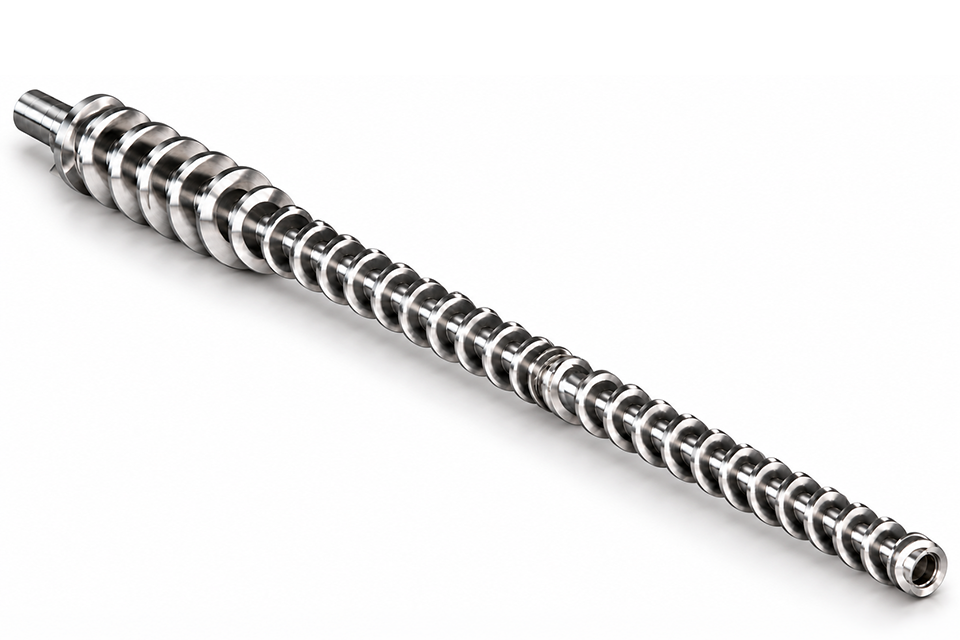
The Heart of the System: Special Conical Screw in the Extruder
Standard systems with cylindrical screws are designed for free-flowing granulate. With light, bulky materials, the intake fails. Pre-compactors such as agglomerators or cutting compactors have to be connected upstream.
The SIKOPLAST extruder generates the necessary pressure with the special conical screw itself.
What this means in practice:
- Light, non-free-flowing materials such as films, nonwovens, fibres and yarns are processed directly. An upstream compaction stage is eliminated.
- No agglomerator, no cutting compactor: no thermal or oxidative pre-stress on the feed material
- Printed and coated materials can be processed
- Also suitable for slightly moist and slightly contaminated materials
- For critical materials, a degassing zone with vacuum pump supplements the process: volatile components are extracted from the melt
- Melting takes place under exclusion of oxygen, without oxidation and without material degradation through air contact
- The screw geometry can be customised to the specific feed material on request
Performance Range and Material Spectrum
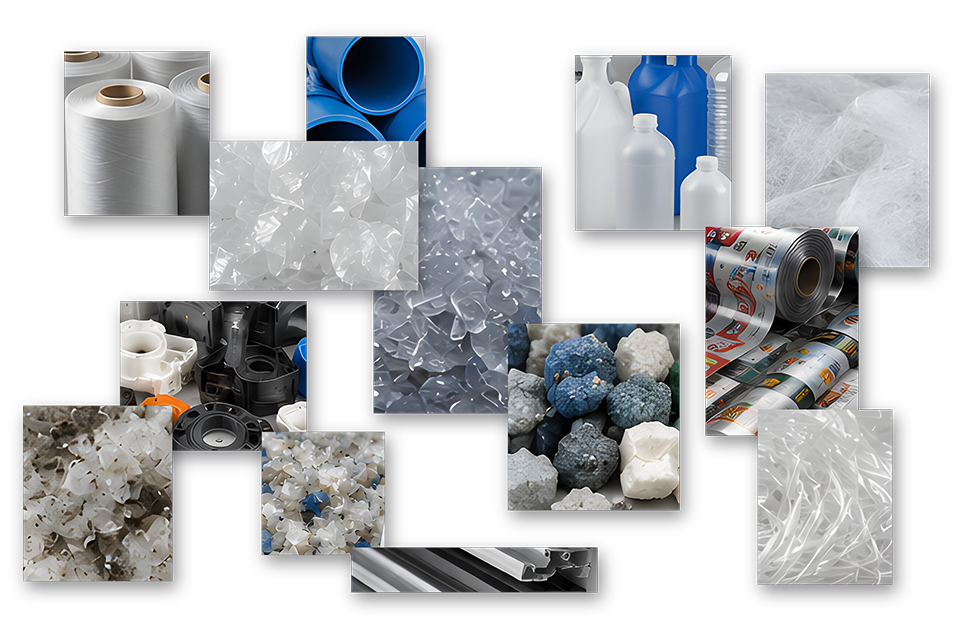
The product range includes standard systems with material throughput capacities from 30 kg/h to over 1,800 kg/h for all thermoplastic plastics. The precise configuration depends on the material, the bulk density and the processing objectives.
Processable materials:
- Films and nonwovens (PE, PP and further thermoplastics)
- Injection-moulded parts, profiles, pipes, hollow bodies
- Fibres, yarns, monofilaments
- Regrind and start-up lumps
- Edge trim and rejects from the plastics processing industry
- Printed and coated materials
- Clean production waste as well as slightly contaminated and moist materials
How the Offline Regranulation System Works
- Pre-shredding: Typically by a cutting mill.
- Pneumatic transport: The pre-shredded feed material is transported by blower into the hopper silo of the extruder.
- Uniform feeding: An agitator integrated in the hopper silo ensures uniform feeding of the extruder regardless of material type. Feeding can take place discontinuously and minimises personnel requirements.
- Melting: In the extruder, the material is gently melted under exclusion of oxygen and without oxidation.
- Filtration: The melt passes through the downstream screen changer. By integrating melt filters, the degree of material purity is increased.
- Granulation: In the granulating head, the melt is processed into granulate and subsequently dried in a centrifuge.
- Discharge: The finished granulate is transported by blower into a big-bag station, a silo or a container.
Modular Design and Configuration
The offline regranulation systems from SIKOPLAST are designed modularly. Planning and component selection are coordinated to suit the respective application and spatial conditions.
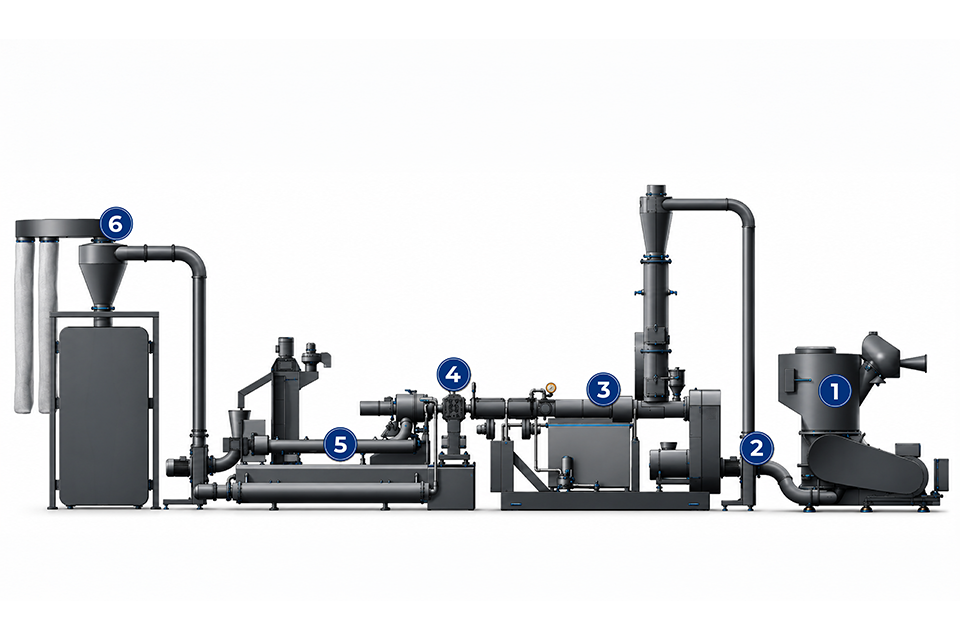
Standard system configuration:
- Cutting mill (1) for pre-shredding the feed material
- Blower (2) for pneumatic transport into the extruder silo
- Extruder with hopper silo (3): the hopper silo serves as a buffer and ensures a constant material throughput
- Screen changer (4) for melt filtration
- Granulation system (5): available as an air-cooled or water-ring-based system as well as an underwater system
- Blower with bagging station (6) for granulate discharge
Feeding options: manually by the system operator, pneumatically via a conveying pipeline, via a conveyor belt or fully automatically with a roll infeed.
On customer request, dosing stations for the addition of additives and/or masterbatches can be integrated. Drive and control components come from German manufacturers, including Siemens and Köllmann.
Offline Regranulation vs. Inline Return: a Direct Comparison
The offline regranulation system and the inline systems from SIKOPLAST (SIKOREX and HYBRID) solve different tasks. The choice depends on the production process, material spectrum and processing objective.
| Criterion | Offline Regranulation System | Inline Systems (SIKOREX / HYBRID) |
|---|---|---|
Process integration | Independent of the production process, separate processing step | Directly integrated into ongoing production |
Output | Regranulate for further processing | Melt, directly back into the production extruder |
Material spectrum | All thermoplastics, broad spectrum incl. injection-moulded parts, profiles, pipes | Specifically nonwovens and PE/PP films, edge trim, roll goods |
Pre-shredding | Cutting mill required | Not required for SIKOREX; cutting mill for HYBRID |
Energy consumption | Higher – two heat stages (extrusion + re-melting at the processor) | Approx. 50% lower for SIKOREX, as granulation stage is eliminated |
Throughput | 30 to over 1,800 kg/h | 30 to 250 kg/h per extruder |
Typical target application | Universal plastics processing, broad material spectrum, flexible feeding | Nonwoven and film production with continuous edge trim return requirements |

Processing of light, non-free-flowing materials without pre-compaction, by design through the special conical screw
No agglomerator necessary: no thermal or oxidative pre-stress on the feed material
Gentle, homogeneous melting under exclusion of oxygen
Performance range 30 to over 1,800 kg/h
Modular design for flexible positioning and individual component selection
Robust, open construction facilitates operation, accessibility and maintenance
FAQ
Why does the SIKOPLAST regranulation system not require an agglomerator?
The special conical screw in the extruder generates the pressure in the intake area that is necessary for light, non-free-flowing materials. An upstream compaction stage is therefore eliminated by design, and with it the thermal and oxidative pre-stress on the material.
Which materials is the system suitable for?
For all common thermoplastic plastics: films, nonwovens, injection-moulded parts, profiles, pipes, fibres, yarns, regrind and hollow bodies. Printed, coated as well as slightly moist and slightly contaminated materials can also be processed.
What throughput capacities are possible?
The product range includes standard systems with capacities from 30 kg/h to over 1,800 kg/h. The precise configuration depends on the material, the bulk density and the processing objective.
How is the system fed?
Feeding can take place manually by the system operator, pneumatically via a conveying pipeline, by conveyor belt or fully automatically via a roll infeed. Since discontinuous feeding is possible, personnel requirements in the material feed area are reduced.
What information is required for an enquiry?
Material and material form, desired throughput capacity, degree of contamination of the feed material, spatial conditions and the processing objective.
What happens with moist or printed materials?
For critical materials, the extruder can be equipped with a degassing zone and vacuum pump. Volatile components are thereby extracted from the melt before they can impair granulate quality.