
 en
en
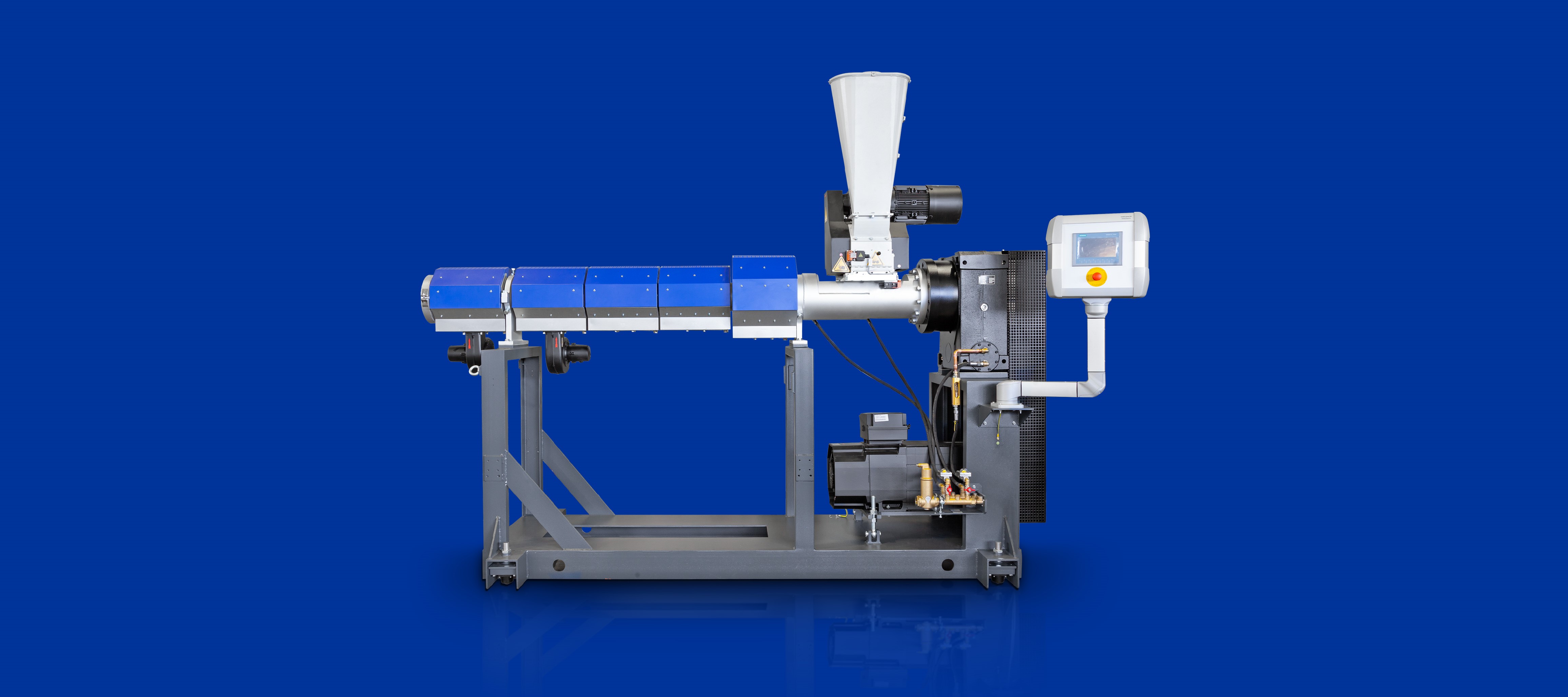
Plastic Recycling Extruders: Conical Screw Technology by SIKOPLAST
Anyone looking to process thermoplastic plastic waste faces a specific challenge: lightweight, non-free-flowing materials such as films, nonwovens, or fibers are difficult to process reliably with standard extruders. Material feeding fails, throughput fluctuates, and upstream densification stages place thermal stress on the material before it even reaches the extruder.
SIKOPLAST has been developing recycling extruders for over 70 years. The foundation of this technology is a conical single screw that directly feeds, compacts, and melts lightweight, non-free-flowing materials without pre-densification. This page provides an overview of SIKOPLAST extrusion technology and explains which of the two extruder types is best suited for which application.
Conical Screw: The Core of SIKOPLAST Extruder Technology
Standard extruders with cylindrical screws are designed for free-flowing granules. With lightweight and bulky materials, feeding force is insufficient. As a result, upstream densification systems such as agglomerators or cutter compactors are required. This not only increases system complexity but also exposes the material to additional heat before it enters the extruder.
The special conical screw developed by SIKOPLAST solves this problem through its geometry. In the feeding zone, it generates the pressure required for lightweight materials — without any external densification stage.
What This Means in Practice:
- Lightweight, non-free-flowing materials such as films, nonwovens, fibers, and yarns can be processed directly
- No thermal or oxidative pre-stressing caused by agglomerators or cutter compactors
- Printed, coated, and slightly moist materials (up to approx. 2% residual moisture) can be processed directly
- For critical materials, a degassing zone with vacuum pump supports the process by extracting volatile substances from the melt before they affect pellet quality
- The screw geometry can be adapted to the specific material if required
- Since the feed zone is wider than the discharge zone, the extruder can efficiently feed loose and bulky materials in large quantities
The melting process itself takes place in an oxygen-free environment — no oxidation and no material degradation caused by air contact. The result is a homogeneous melt with stable quality.
Two Extruder Types for Different Applications
SIKOPLAST offers two extruder variants. Both are based on conical screw technology but differ in application area, output, and material range.
Single-Screw Extruder

The single-screw extruder feeds production waste directly back into the running process as melt — without pelletizing. Developed for the nonwoven and PE/PP film industry.
➡ More about single-screw extruders
➡ See also: SIKOREX

Which Extruder Fits Which Application?
| Feature | Single-Screw Extruder | Offline Extruder |
|---|---|---|
Application Area | Inline, directly in the production line | Offline, independent from production |
Output | Melt (direct recirculation) | Regranulate |
Material Range | Nonwovens, PE/PP films, edge trim, rolls | All thermoplastics, wide material range |
Throughput | 30–250 kg/h per extruder | 30–1,300+ kg/h |
Pre-Shredding | Not required | Yes, usually via granulator |
Integration Into Existing Production Lines

Both extruders are modular in design and can be integrated into existing production environments. They can be combined with additional SIKOPLAST components such as screen changers, pelletizing systems, granulators, silos, conveyor belts, and dosing stations for additives and masterbatches.
Component layout and system configuration are adapted to local production conditions. Drives and control components are supplied by German manufacturers, including Siemens and Koellmann.
FAQ
Which materials are SIKOPLAST recycling extruders designed for?
The extruders process thermoplastic plastics, including films, nonwovens, injection-molded parts, profiles, pipes, fibers, yarns, hollow bodies, and regrind. Printed, coated, and slightly moist materials can also be processed.
Why does the SIKOPLAST extruder not require an agglomerator?
The conical screw geometry generates the pressure required for lightweight, non-free-flowing materials directly in the feeding zone. Therefore, no upstream densification stage is required.
What throughput capacities are possible?
The offline extruder covers capacities from 30 kg/h to over 1,300 kg/h. The single-screw extruder is designed for 30–250 kg/h per extruder. The exact configuration depends on the material, bulk density, and processing goals.
Can an existing extruder be retrofitted with SIKOPLAST components?
Yes. Screen changers, pelletizing systems, and other components can be connected to standard extruders via adapter flanges. Whether full integration is possible depends on the existing system configuration.
What information is required for a quotation?
Material type and form, desired throughput capacity, contamination level of the input material, available installation space, and the intended processing goal (regranulate or direct melt recirculation).