
 en
en
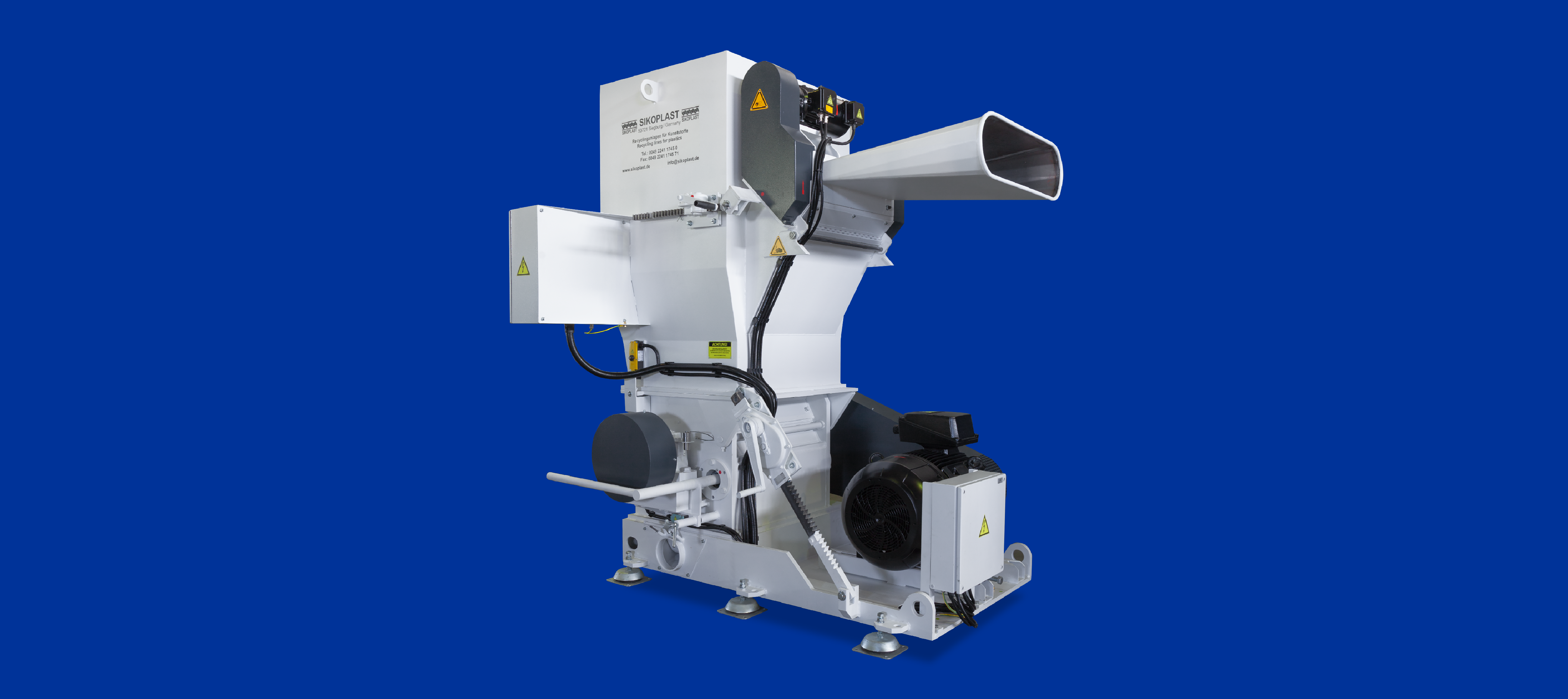
Cutting Mills from SIKOPLAST
Precise size reduction is the foundation of high-quality recycling. SIKOPLAST cutting mills transform production waste into defined regrind material, efficiently and with reliable process stability. Our systems are designed to ensure consistent material flow while reproducibly achieving the desired particle size.
Typical applications include plastics recycling and the size reduction of intermediate products. Demanding applications in the chemical or food industries can also be realized, provided the material properties and hygiene requirements allow it.
From in-house recycling to post-consumer processing, our cutting mills provide the ideal solution for a closed-loop material cycle. In production environments, they maximize raw material efficiency by directly recycling sprues and defective parts. In large-scale recycling operations, they reliably process post-consumer plastics and hollow bodies into high-quality, homogeneous regrind material. This ensures both economical waste reduction directly at the machine and an excellent basis for the regranulation of demanding secondary raw materials.
Our Solution: The SIKOPLAST Cutting Mill
SIKOPLAST cutting mills are configured to match both your material and your production line integration requirements. The target particle size is defined by interchangeable screen perforations. If variable drive control is implemented, the rotor speed can also be adapted to specific material properties, allowing the cutting behavior to be optimized precisely.
Different feeding options are available depending on the application:
- Roller feeders for roll goods
- Conveyor belts for loose input material
- Cyclone systems for direct suction feeding from the process line
Operating Principle: How Defined Regrind Material is Produced

Inside the cutting mill, the input material is captured in the cutting chamber and processed by rotor and stator knives. The resulting regrind passes through a screen. Only particles matching the selected perforation size are discharged, while larger pieces remain in the cutting chamber until the target size is reached.
An optional discharge screw conveyor beneath the screen ensures continuous material removal and reliably prevents material buildup, maintaining a stable process flow.
Process Overview
- Material Feeding: The input material enters the grinding chamber and is immediately captured by the rotating rotor knives.
- Size Reduction: Through the precise interaction of rotor and stator knives, the material is reduced into homogeneous regrind using controlled shear and cutting forces.
- Classification: A screen mounted beneath the grinding chamber acts as a defined barrier. Only material that has reached the desired particle size can leave the cutting chamber.
- Discharge & Material Removal: The integrated discharge screw conveyor (optional) continuously removes the granulate from the machine, enabling reliable transport through extraction or conveying systems.
This process logic makes the cutting mill a reliable system component whenever a clearly defined particle size distribution is required.
Technical Features That Make the Difference in Daily Operation
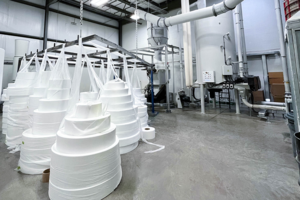
In industrial operation, system availability and service life are critical factors. For this reason, the machine design focuses on maintenance accessibility and component protection. A robust welded steel housing forms the foundation of the system. External bearings reduce exposure to dust and heat inside the cutting chamber, increasing service life while simplifying maintenance.
For high-throughput applications, powerful drive systems are available. SIKOPLAST cutting mills are designed for throughput capacities of up to 2,000 kg/h. Depending on the configuration, motor power can reach up to 110 kW. Knife geometry is optimized to ensure stable material feeding and minimize operational blockages.
Key Advantages at a Glance

Throughput capacities up to 2,000 kg/h depending on configuration
Defined particle size through easily exchangeable screen inserts
External bearings for protection against dust and thermal stress
Flexible feeding options via roller feeder, conveyor belt, or blower system with cyclone
Robust construction designed for continuous industrial operation
Which Cutting Mill is Suitable for Which Material?
Material properties determine the most suitable system configuration. Key factors include shape, toughness, and the required regrind size. The feeding method also plays an important role.
Plastics
Whether processing standard polymers such as PE, PP, PET, and PVC or engineering plastics like PA and ABS, the machine configuration is adapted to the material. Hard components can usually be processed directly, while tough films and fibers require specialized knife geometry to ensure clean cuts without material wrapping. The target particle size is always precisely controlled via the screen system.
Hollow Bodies, Pipes, and Sheets
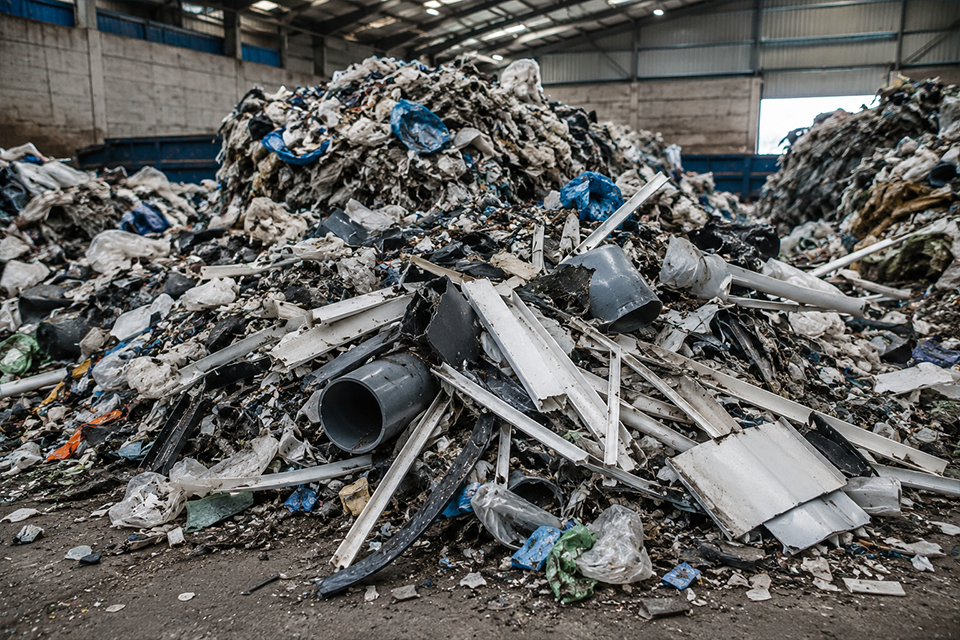
For bulky components such as canisters, pipes, or sheet material, reliable feeding is essential. Depending on wall thickness and dimensions, pre-shredding may be necessary to ensure proper material handling. SIKOPLAST cutting mills are designed to safely capture and efficiently process even bulky materials.
Production Waste and Intermediate Products
Whether sprues, startup lumps, or punched grids, the focus is on direct material recycling. The cutting mill converts waste into homogeneous regrind that can immediately be returned to the production process without quality loss. This ensures a continuous material flow while reducing raw material costs.
Application Areas
SIKOPLAST cutting mills are used whenever material must be reliably converted into regrind material. Typical applications include:
Service and Spare Parts
With cutting mills, proper system configuration is crucial. SIKOPLAST therefore supports customers in system selection, configuration, and integration. Even after commissioning, operations remain predictable because spare parts are available over the long term. This minimizes downtime risks and simplifies maintenance planning.
FAQ
Which regrind sizes are possible?
The particle size is determined by the selected screen. The configuration depends on the material and the downstream process.
Which throughput capacities are realistic?
System design depends on the material, feeding method, and required particle size. Systems with capacities up to 2,000 kg/h are available.
Can the cutting mill be fed automatically?
Yes. Roller feeders, conveyor belts, or cyclone-based pneumatic feeding systems can be implemented depending on the material.
What is the advantage of variable speed control?
Variable speed allows the cutting behavior to be adapted to the material and process requirements. This can improve regrind quality and reduce fine particle content.