
 en
en
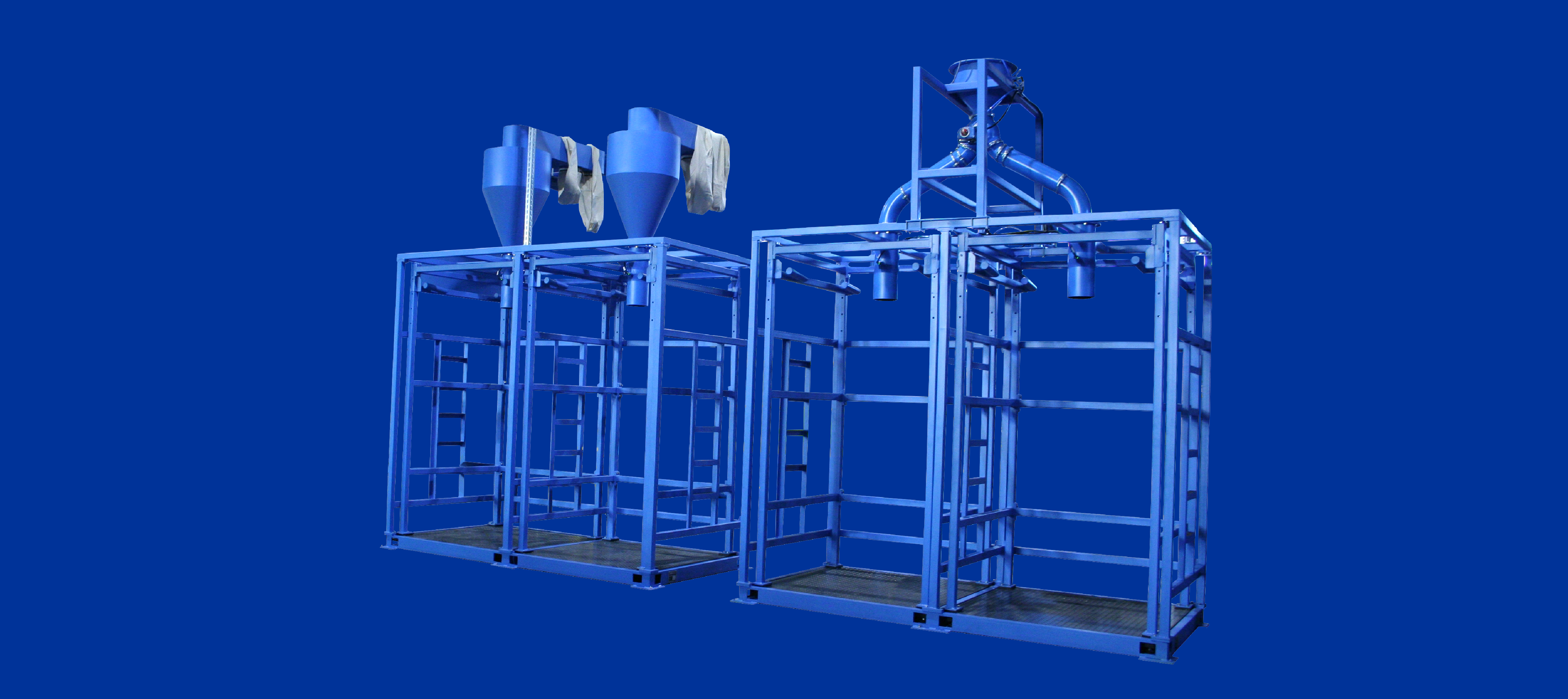
Big Bag Filling Station
A SIKOPLAST Big Bag Filling Station helps you safely fill bulk materials such as flakes, granules, or regrind into big bags, sacks, octabins, and other containers while ensuring consistent filling quantities. The station is designed for companies that want to stabilize their packaging processes and improve material flow planning. The systems can be flexibly adapted and integrated into existing production or recycling lines, allowing current processes to be expanded without major modifications.
Companies that value structured workflows, reduced manual handling, and reliable filling quantities particularly benefit from our industrial solutions. The technology is designed for continuous operation and supports clean material handling while minimizing incorrect filling processes.
We also manufacture customized stations for different bag sizes and even rigid containers.
Optionally, we offer fully automatic dual filling stations. While one full Big Bag is removed and replaced, the filling process on the opposite side continues without interruption thanks to a pneumatic diverter valve that redirects the material flow. Level sensors or weighing systems detect when the diverter must switch automatically.
Our Solution – The SIKOPLAST Bagging Station

The SIKOPLAST Big Bag Bagging Station combines a robust Big Bag support frame with a tightly sealed filling spout. Depending on the material and process requirements, the system can be expanded with additional equipment such as:
- Gravimetric weighing technology
- Optical level sensors
- Acoustic or visual signal devices
- Dust extraction units
- Automatic bag clamping systems
This creates a filling process that remains stable even with fluctuating material flows while significantly reducing material loss.
Operation is controlled via a clearly structured control system. This reduces operator errors and simplifies employee training. Maintenance remains straightforward because wear parts are easily accessible and mainly consist of standardized components. This makes the station an economically efficient long-term solution for both recurring products and changing bulk materials.
Filling Process Workflow
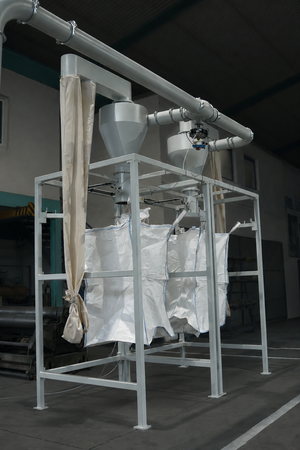
The filling process is structured to ensure safe and efficient handling of Big Bags. Each step is designed for easy integration into daily operations.
1. Positioning and Securing the Big Bag
The Big Bag is attached to the holding points and aligned securely. The station ensures the bag remains stable during filling.
2. Connection to the Filling Spout
The filling spout is tightly connected to the Big Bag. This prevents material loss and ensures controlled transfer from the conveying system into the bag.
3. Start of the Filling Process
The material feed begins automatically and can operate:
- Gravimetrically (weight-based)
- Volumetrically (volume-controlled)
Once the target weight or volume is reached, the material flow stops automatically. This reduces overfilling and minimizes rework.
4. Dust Extraction (Optional)
Displaced air generated during filling is routed through a dust extraction system. Filters or cyclones reduce dust emissions and improve workplace conditions.
5. Process Completion
After filling, the Big Bag is secured and sealed, ready for storage or shipment. The repeatable workflow supports consistent product quality and simplifies downstream process planning.
Applications of the Big Bag Filling System
The Big Bag Filling System can be used across various industries and is especially suitable for:

PET flakes, regrind, and plastic granules

Engineering plastics in granular or powder form

Fine bulk materials with defined flow characteristics

Materials filled in batches or continuous processes
The system can be connected to continuous material flows, such as after drying, sorting, or extrusion processes, as well as to batch-based production operations. Typical Big Bag filling weights range from approximately 500 to 1,500 kg per bag, depending on material density.
Why SIKOPLAST?
For many years, SIKOPLAST has been developing machinery for the plastics recycling industry and designing equipment proven in daily industrial operation. The Big Bag Filling Station is easy to maintain and engineered for reliable operation even under changing production conditions.
A major advantage is the long-term availability of spare parts. This keeps maintenance predictable and ensures fast response times in service cases, increasing system uptime while reducing downtime costs.
Key Advantages of the SIKOPLAST Filling Station
Robust construction with low wear costs
Clear and user-friendly control system reducing operator errors
Easy accessibility for maintenance work
Modular expandability for future requirements
Reliable filling accuracy minimizing rework
Optional automatic diverter valve, level sensors, platform, and weighing system
This provides companies with an economically efficient and long-lasting filling solution.
FAQ
How many Big Bags can be filled per hour?
Depending on the system configuration and material properties, approximately six to twelve Big Bags per hour can typically be filled.
Which materials can be filled?
The station is suitable for flakes, regrind, granules, and powdery bulk materials, provided they are free-flowing.
Can the filling station be expanded?
Yes. Additional modules such as dosing systems, dust extraction, buffer hoppers, or pallet handling can be retrofitted.
Can the Big Bag Filling Station be integrated into existing systems?
The station can be connected to silos, conveyors, or dryers without requiring major structural modifications.
How do maintenance and operation affect economic efficiency?
Thanks to the maintenance-friendly design, easily accessible wear parts, and simple control system, downtime remains minimal. This reduces long-term operating costs and increases equipment availability.